Showing posts with label 2008 US Election. Show all posts

Tuesday, January 20, 2009

Obama's Vindication of Thomas Paine

Thomas Paine is the unsung hero of the American Revolution, the man who first inspired the total break with the Untied Kingdom in his pamphlet Common Sense. He gave voice to what heretofore had been unmentionable, a clean and irrevocable independence from England.

Yet Paine would be ostracized and shunned later in life for his strong advocacy of real liberty and freedom for all Citizens of the New Republic. Soon as in most Revolutions one group, Southern Men of Property, the Dixie Aristocracy co-opted and hijacked the American Revolution.

No surprise then that today in 2009 Barrack Obama would borrow so heavily from Americas most famous Radical of the Revolution, the man who so horrified those who would declare a black man sub human fit only to be counted as three-fifths of a human being, and only for the purpose of granting the Southern Counter revolutionaries a greater share of the seats in Congress.

Thomas Paines ideas have a definite place in President Obamas poltitics.

I wonder if he shares Paines Deist view of Religion. I sure hope that would be REAL CHANGE!

DeWayne H


"I stand here today as hopeful as ever that the United States of America will endure, that it will prevail, that the dream of our founders will live on in our time."

Barack Obama, 18 January 2009

by John Nichols on 01/20/2009

President Barack Obama swore on Tuesday to protect and defend a Constitution that was not written in anticipation of his presidency--that was not, in fact, written in anticipation of his citizenship.

And that is where we should begin to measure the historic turning that has taken place this day.

The American experiment began with its promise constricted by the narrow vision of Virginia plantation owners who saw an African-American as three-fifths of a human being--and that scant measure only for the purpose of granting the South a greater share of the seats in a Congress that would for the better part of a century be all white, all male and all of the propertied class.

America was founded on the original sins of human bondage and violent discrimination.

Barack Obama's inauguration does not erase that history. As W.E.B. Du Bois told us, "One is astonished in the study of history at the recurrence of the idea that evil must be forgotten, distorted, skimmed over...We must forget that George Washington was a slave owner... and simply remember the things we regard as creditable and inspiring. The difficulty, of course, with this philosophy is that history loses its value as an incentive and example; it paints perfect man and noble nations, but it does not tell the truth."

Obama's inauguration turns the tables on the founders.

Those who proposed and accepted the Constitution's initial compromises, have been put in their place--not dismissed, but confirmed, finally and unequivocally, as having possessed a vision insufficient for the America that would be.

That goes for Jefferson, Madison, even for Washington (Obama's "man who led a small band of farmers and shopkeepers in revolution against the army of an Empire")--all the "good guys" who were not good enough to reject the crude calculus that in the words of Du Bois "classed the black man and the ox together."

Yet Obama speaks, often and favorably, of the founders, describing them in Philadelphia just days before his inauguration as "that first band of patriots... who somehow believed that they had the power to make the world anew."

The reference to making the world anew was borrowed--imprecisely-- from one of founders. Thomas Paine called his comrades to the revolutionary cause with the cry: "We have it in our power to begin the world over again. A situation, similar to the present, hath not happened since the days of Noah until now. The birthday of a new world is at hand, and a race of men, perhaps as numerous as all Europe contains, are to receive their portion of freedom from the event of a few months."

Obama quoted frequently from Paine, and particularly from Common Sense, during his campaign for the presidency. And he did so, again, on Tuesday, referencing Paine in a speech that spoke of a "return to these truths" of the American experiment.

So let us mark this day with remembrance, of who we are and how far we have traveled. In the year of America's birth, in the coldest of months, a small band of patriots huddled by dying campfires on the shores of an icy river. The capital was abandoned. The enemy was advancing. The snow was stained with blood. At a moment when the outcome of our revolution was most in doubt, the father of our nation ordered these words be read to the people: "Let it be told to the future world...that in the depth of winter, when nothing but hope and virtue could survive...that the city and the country, alarmed at one common danger, came forth to meet [it]."

That line is from Paine's The Crisis, which George Washington did, in fact, have read to the troops in the most difficult days of the revolutionary struggle.

From that reference, on Tuesday, Obama continued:

America. In the face of our common dangers, in this winter of our hardship, let us remember these timeless words. With hope and virtue, let us brave once more the icy currents, and endure what storms may come. Let it be said by our children's children that when we were tested we refused to let this journey end, that we did not turn back nor did we falter; and with eyes fixed on the horizon and God's grace upon us, we carried forth that great gift of freedom and delivered it safely to future generations.

It was right that Obama turned to Paine.

When the Pennsylvania Assembly considered the formal abolition of slavery in 1779, it was Paine who authored the preamble to the proposal.

Paine's fervent objections to slavery led to his exclusion from the inner circles of American power in the first years of the republic. He died a pauper. Only history restored the man--and his vision.

And on this day, this remarkable day, Thomas Paine is fully redeemed.

Paine, to a greater extent than any of his peers, was the founder who imagined a truly United States that might offer a son of Africa and of America not merely citizenship but its presidency.

Barack Obama is wise to associate himself with the better angels of our history, including the architects of our republic who, for all their imperfections, issued--as the Rev. Martin Luther King Jr. noted on another crowded day in Washington--"wrote the magnificent words of the Constitution and the Declaration of Independence" and in so doing "(signed) a promissory note to which every American was to fall heir. This note was a promise that all men, yes, black men as well as white men, would be guaranteed the 'unalienable Rights' of 'Life, Liberty and the pursuit of Happiness.' It is obvious today that America has defaulted on this promissory note, insofar as her citizens of color are concerned. Instead of honoring this sacred obligation, America has given the Negro people a bad check, a check which has come back marked 'insufficient funds.'"

"But," concluded King, "we refuse to believe that the bank of justice is bankrupt."

The bank of justice, unlike those of Wall Street, has proven to be solvent.

Our new president--and we the people--do well to recognize those who signed the promissory note.

But that does not mean that we should presume that the founders were all equally wise, or equally good.

It was Paine, the most revolutionary of their number, who proved to be the wisest, and the best, of that band of patriots--for his time, and for this time.

Today belongs to Barack Obama.

But it also belongs to Thomas Paine.

When our new president says that his election proves "the dream of our founders is alive in our time," it is Paine's dream of which he speaks.

That dream may not be fully realized. But it is alive--more, indeed, today than at any time in the history of a land that might yet begin our world over again.


Presidential Inauguration

The Inauguration of Barack Obama as the 44th President of the United States of America.

In this Internet Age change comes to whitehouse.gov while he gives his inaugural address.

And yes the White House now has an Official Blog! If John Kennedy was the first Television President, Barack Obama is our first Web President!

A lot of commentary and analysis on the web I will post some of the most insightful and the best photos from this Historic Day.


The White House Blog


Tuesday, January 20th, 2009 at 12:01 pm

Change has come to WhiteHouse.gov

Welcome to the new WhiteHouse.gov. I'm Macon Phillips, the Director of New Media for the White House and one of the people who will be contributing to the blog.

A short time ago, Barack Obama was sworn in as the 44th president of the United States and his new administration officially came to life. One of the first changes is the White House's new website, which will serve as a place for the President and his administration to connect with the rest of the nation and the world.

Millions of Americans have powered President Obama's journey to the White House, many taking advantage of the internet to play a role in shaping our country's future. WhiteHouse.gov is just the beginning of the new administration's efforts to expand and deepen this online engagement.

Just like your new government, WhiteHouse.gov and the rest of the Administration's online programs will put citizens first. Our initial new media efforts will center around three priorities:

Communication --
Americans are eager for information about the state of the economy, national security and a host of other issues. This site will feature timely and in-depth content meant to keep everyone up-to-date and educated. Check out the briefing room, keep tabs on the blog (RSS feed) and take a moment to sign up for e-mail updates from the President and his administration so you can be sure to know about major announcements and decisions.

Transparency -- President Obama has committed to making his administration the most open and transparent in history, and WhiteHouse.gov will play a major role in delivering on that promise. The President's executive orders and proclamations will be published for everyone to review, and that’s just the beginning of our efforts to provide a window for all Americans into the business of the government. You can also learn about some of the senior leadership in the new administration and about the President’s policy priorities.

Participation --
President Obama started his career as a community organizer on the South Side of Chicago, where he saw firsthand what people can do when they come together for a common cause. Citizen participation will be a priority for the Administration, and the internet will play an important role in that. One significant addition to WhiteHouse.gov reflects a campaign promise from the President: we will publish all non-emergency legislation to the website for five days, and allow the public to review and comment before the President signs it.

We'd also like to hear from you -- what sort of things would you find valuable from WhiteHouse.gov? If you have an idea, use this form to let us know. Like the transition website and the campaign's before that, this online community will continue to be a work in progress as we develop new features and content for you. So thanks in advance for your patience and for your feedback.

Later today, we’ll put up the video and the full text of President Obama’s Inaugural Address. There will also be slideshows of the Inaugural events, the Obamas’ move into the White House, and President Obama’s first days in office.


WASHINGTON (CNN) – Could an African-American President be the one who finally ends the cultural civil war that has been roiling American politics since the 1960s: liberal versus conservative, red versus blue, Democrat versus Republican? Both Bill Clinton and George Bush set out to end it. Clinton was "new Democrat." Bush was the compassionate conservative and the uniter. Both got trapped in the culture wars and ended up leaving the country more divided than ever. Clinton and Bush were the bookend Presidents of the Baby Boom generation.

Obama is technically a Baby Boomer – he was born near the tail end of the Baby Boom. But his approach and philosophy look beyond the Baby Boomers’ experience. He wrote in "The Audacity of Hope" about his desire to move beyond "the psychodrama of the Baby Boom generation –- a tale rooted in old grudges and revenge plots hatched on a handful of college campuses long ago."


Big goals, and a clear departure from the past
Posted: 12:27 PM ET

WASHINGTON (CNN) — The call to unity is very much Obama’s trademark –- reaching across barriers, ending "the recriminations and worn-out dogmas." That’s what he means by changing politics in Washington. And right away, he addresses some clear departures from the Bush approach.

The choice between safety and ideals is false, he says. Without a watchful eye, the market can spin out of control. There's a clear acknowledgment of the global warming crisis ("the way we use energy strengthen our adversaries and threaten our planet.")

He's one of the few modern Presidents who has reached out to "non-believers" as well as Christians, Muslims, Jews and Hindus.

"The world has changed, and we must change with it." His theme of "change" carried him through the campaign. Voters saw it as change from Bush. Now he is using it to call for big policy changes, calling this "a moment that will define a generation" — very much like Kennedy in 1961.

"Remaking America" — no small ambition, starting with the literal reconstruction of our infrastructure. He has "big plans" –- and a big crisis that can help him carry them through.

But still, there's an overriding realism. His answer to the old partisan debate: "The question is not whether our government is too big or small, but whether it works." It’s the pragmatist’s answer. Does it work?


Dr King said it might take 40 years. It's been 45 years, I can wait another hour
Ronald Brisbon
Washington resident

Obama: Challenges will be met
From The Daily Scotsman;


President Barack Obama warned of "gathering clouds and raging storms" today.
But he also delivered a message of hope as he was inaugurated as the first black President of the United States.

He said: "Every so often the oath (of office) is taken amidst gathering clouds and raging storms".

At such times America had to remand true to our founding document", he said.

And he added: "Today I say to you that the challenges we face are real.
"They are serious and they are many. They will not be met easily or in a short span of time. But know this, America – they will be met."

Describing the challenges ahead, he said: "That we are in the midst of crisis is now well understood.

"Our nation is at war, against a far-reaching network of violence and hatred.

"Our economy is badly weakened, a consequence of greed and irresponsibility on the part of some, but also our collective failure to make hard choices and prepare the nation for a new age.

"Homes have been lost; jobs shed; businesses shuttered. Our health care is too costly; our schools fail too many; and each day brings further evidence that the ways we use energy strengthen our adversaries and threaten our planet."

But he said people had chosen "hope over fear, unity of purpose over conflict and discord".

President Obama said: "On this day we come to proclaim an end to the petty grievances and false promises, the worn out dogmas, that for far too long have strangled our politics."

Evoking the pioneering spirit of America, Mr Obama said that it was the "risk-takers, the doers, the makers of things" that had carried America "up the long, rugged path towards prosperity and freedom".
He said: "Time and again these men and women struggled and sacrificed and worked till their hands were raw so that we might have a better life."

He went on: "Starting today we must pick ourselves up, dust ourselves off, and begin again the work of America."

The economy, he said, needed "bold and swift" action to create jobs and stimulate growth.

He also called for a need to restore "the vital trust between a people and their government".

In a bid to rebuild America's standing oversees, Mr Obama said: "To all other peoples and governments who are watching today, from the grandest capitals to the small village where my father was born, know that America is a friend of each nation and every man, woman and child who seeks a future of peace and dignity, and that we are ready to lead once more."

He added that earlier generations of Americans had faced down fascism and communism "not just with missiles and tanks, but with sturdy alliances and enduring convictions".

He said: "Power alone cannot protect us."

The US would "begin to responsibly leave Iraq to its people and forge a hard-earned peace in Afghanistan".

President Obama said his country would work to lessen the nuclear threat and "roll back the spectre of a warming planet".

As a country "shaped by every language and culture" the President vowed to "play its role in ushering a new era of peace".

Mr Obama continued: "Our challenges may be new. The instruments with which we meet them may be new. But those values upon which our success depends – hard work and honesty, courage and fair play, tolerance and curiosity, loyalty and patriotism – these things are old. These things are true. They have been the quiet force of progress throughout our history."

As such, he called for a "return to these truths".


Obama sworn in as 44th U.S. president


The Los Angeles Times
The capital is crowded with color and celebration as the nation's first black president takes office. Despite the challenges of wars and a foundering economy, he rides a wave of optimism.
By Cathleen Decker
9:06 AM PST, January 20, 2009
Reporting from Los Angeles -- Barack Hussein Obama was sworn into office as the nation's 44th president today, assuming leadership of a nation riven by war and economic despair but embracing the improbable ascension of a first-term Illinois senator as the nation's first black chief executive.

With his hand on a Bible used by Abraham Lincoln more than a century ago, Obama repeated the 35-word oath before a rapturous and massive crowd, supplemented across the country with separate, if just as boisterous, celebrations. Minutes before Chief Justice John G. Roberts Jr. ushered Obama into office, former Delaware Sen. Joseph Biden became the nation's new vice president with the assistance of Associate Justice John Paul Stevens.

The day unfolded with the nation invoking the familiar rituals of a peaceful change in power, although history hung in the air. On the stand as Obama took the oath were members of the Supreme Court, Congress and family and friends of the incoming leaders.

After formally becoming president, Obama was due to deliver an inaugural address that will warn Americans of difficult days ahead and call for a new spirit of bipartisan sacrifice to solve the varied problems facing the country -- themes familiar from Obama's long trek to the White House.

Obama and his wife, Michelle, and Biden and his wife, Jill, began their day by attending services at St. John's Episcopal Church, the traditional destination for an incoming president, located across Lafayette Park from the White House.

Then they traveled to the president's residence for coffee with outgoing President Bush and Vice President Cheney, along with House and Senate leaders. Bush and his wife, Laura, met the Obamas at the north portico, where they embraced and exchanged greetings. The group later caravaned to the Capitol for the swearing-in ceremony, charting a reversal of the path that Obama's inaugural parade will take as it kicks off later today.

Obama woke this morning to a city overwhelmed with revelers. Suburban parking lots for the city's subway system were filled before dawn, and masses of people thronged on foot toward entrances to the National Mall. With hours to go before the ceremony, the Mall was packed from the Capitol west to the Washington Monument, and overflow crowds spilled onto the grounds of the Lincoln Memorial as well.

Yet concerns that the crush of people would prompt security crises, massive traffic tie-ups and cellphone network implosions were largely unrealized in the early hours. The crowds were docile, if cold, and temperatures were expected to top out in the 30s.

The day ushered out the eight-year presidency of George W. Bush, who came into office vowing to unite the country and led the nation through the tumult of the Sept. 11 terrorist attacks, only to founder over an ill-managed war in Iraq, lengthening battles in Afghanistan and a downward-spiraling economy.

But the bracing turnover was cultural as much as political, as the nation grasped the import of November's election again: After 220 years, for the first time it was not a white man taking the oath of office. The facts of Obama's parentage -- he is the son of a Kenyan father and a white Kansas-born mother -- rippled across the inauguration platform and the assembled crowd, both more diverse than at past inaugurations.

From black Americans who had lived through the civil-rights era and who had never presumed they would see such a day as this, to Americans whose experience of discrimination is limited to history books, Obama's journey has evoked strong emotions and echoes. He took the oath of office with a view westward toward the Lincoln Memorial and its great marble likeness of the president who freed America's slaves. The steps of the very same memorial welcomed, in 1939, black contralto Marian Anderson after she was refused entrance to Constitution Hall, and in 1963, Martin Luther King Jr. for his "I Have a Dream" speech. On Sunday, at the first of the inaugural festivities, a concert at the Lincoln Memorial, Obama sat there as president-elect, his dream realized.

Before the swearing-in, Nelson and Tina Daniel stood in the shoulder-to-shoulder crowd at the foot of the Washington Monument, halfway between the Lincoln Memorial and the Capitol. The Los Angeles residents had staked out their position at 5 a.m.

"This is big history," said Nelson Daniel, a 63-year-old African American. "Once-in-a-lifetime experience. My mother and grandparents dreamed of it. I have a chance to witness it for them."

Also in the crowd was Gloria Washington-Lewis Randall, an African American from Alabama who spent 2 1/2 weeks in jail for participating in a civil-rights demonstration in 1963. Now, at 62, she watched the ceremonies via one of the giant viewing screens set up on the Mall.

"I'm totally ecstatic," she said. "You don't really notice the cold out here. It's a warmness that's coming up. Because no more will we be called black or white. We'll be called Americans."

A counterpoint to the enthusiasm greeting Obama was the grim reality facing the new administration. Obama inherits the wars in Iraq and Afghanistan, anti-American sentiment around the globe and, at home, the harshest economic crisis since the Great Depression. Much of his transition was spent trying to infuse optimism that his proposals will work, while simultaneously warning Americans that recovery will take years, not months.

Obama's improbable journey began less than two years ago when, with what even he acknowledged was "a certain presumptuousness," he announced his candidacy for president in a speech in Springfield, Ill., Lincoln's adopted hometown. At the time, Obama had served only two years in the United States Senate.

Few gave him strong odds at the beginning of his quest. Hillary Rodham Clinton was the front-runner and all-but-certain nominee, but as the pre-primary polling gave way to the sentiments of actual voters, her veneer of inevitability cracked. Obama's campaign was built on soaring rhetoric and substance -- his early opposition to the Iraq war contrasted sharply with Clinton's vote for it.

Less measurable early on -- but ultimately more potent -- was his emotional reach among voters who wanted to turn a page on the divisive politics that many felt Clinton personified. On their backs, and on the backs of young voters whose eventual turnout was suspect until election day, Obama built a stunning, tech-savvy organization. His campaign appearances in the general election regularly drew numbers unseen in past campaigns -- 100,000 in St. Louis, 90,000 in Manassas, Va., 75,000 in Kansas City, Mo.

Obama upended the race with a smashing victory in the first contest, the Iowa caucuses, but Clinton came back days later to win in New Hampshire, setting up a grinding primary contest that would last until she relented in June. Like Biden, himself a candidate in 2008, Clinton would find a place in the Obama Administration hierarchy, as the designated secretary of State.

The general election saw Obama trounce Arizona Sen. John McCain, who fought against a sweeping Democratic voter registration effort but ultimately fell under the weight of the economic downturn. McCain also suffered from the election's anti-Republican cast; the party lost seats in the House and Senate, and Bush leaves office for his Texas retirement with a positive approval rating at less than three in 10 Americans.

Obama, by contrast, has strengthened his hand since election day. Several polls have placed the percentage of Americans who say they feel optimistic about his tenure at more than seven in 10, well above his 53%-46% margin over McCain.

The inaugural festivities opened Sunday with the star-studded concert at the Lincoln Memorial, where Obama invoked an optimistic yet sober approach.

"There is no doubt that our road will be long," Obama said. "That our climb will be steep. But never forget that the true character of our nation is revealed not during times of comfort and ease, but by the right we do when the moment is hard. I ask you to help me reveal that character once more."

On Monday, Obama, Biden and their families took part in several community-service events to commemorate the King holiday. Obama toured a shelter for homeless teenagers, demonstrating his technique as he took up a roller to coat a wall with "Laguna blue" paint. At his next stop, where local service groups were working on projects to benefit American troops, Obama returned to the notion that all Americans will have to pitch in to restore the nation's momentum.

"I am making a commitment to you as the next president that we are going to make government work," he said. "But . . . government can only do so much. If we're waiting for someone else to do something, it never gets done."

Obama's last night before assuming the presidency was spent at three dinners meant to reinforce his message of bipartisanship. They honored McCain; former Secretary of State Colin Powell, a Republican who had endorsed Obama before the election; and Biden.

"We'll see you tomorrow," Obama said to huge applause.

Today dawned, and the Mall swarmed not only with security forces -- seen and unseen -- but also those who seized on the inauguration as their personal ticket out of economic malaise. T-shirts, knit caps, key chains, pencils, coffee mugs, American flags, all decorated with Obama's face, were being vigorously hawked across the district. The chaotic display competed with the formal red-white-and-blue bunting that draped the graceful old Capitol, the stately backdrop for the drama.

cathleen.decker@latimes.com

Richard Simon in Washington contributed to this article.


New President, New Limousine

Sunday, January 4, 2009

GOP Whining, Bitching and Moaning


Krugman really hits this one squarely in the Elephants trunk! Instead of examining the cause of Barack Obamas landslide win and the repudiation of the GOP in Congress, the GOP pundidts and nabobs have been busy...

Whining,bitching and moaning about their and our countries lot, as if the voters made a mistake in November! As if the entire global financial meltdown has not exposed the Great LIE's our Western Capitalist society has been built on!

Right...

Which means the all important task of tearing down and rebuilding the GOP awaits another day.

I have a suggestion, just disband and allow a new party to develop with fresh ideas.

It's time for GOP to stop whining

PAUL KRUGMAN It was a grand ride for a while, but in the end the Southern strategy led the GOP into a cul-de-sac.
Posted: 01/03/2009 01:40:50 AM PST

As the new Democratic majority prepares to take power, Republicans have become, as Phil Gramm might put it, a party of whiners.

Some of the whining almost defies belief. Did Alberto Gonzales, the former attorney general, really say, "I consider myself a casualty, one of the many casualties of the war on terror"? Did Rush Limbaugh really suggest that the financial crisis was the result of a conspiracy, masterminded by that evil genius Chuck Schumer?

But most of the whining takes the form of claims that the Bush administration's failure was simply a matter of bad luck — either the bad luck of President Bush himself, who just happened to have disasters happen on his watch, or the bad luck of the GOP, which just happened to send the wrong man to the White House.

The fault, however, lies not in Republicans' stars but in themselves. Forty years ago the GOP decided, in effect, to make itself the party of racial backlash. And everything that has happened in recent years, from the choice of Bush as the party's champion, to the Bush administration's pervasive incompetence, to the party's shrinking base, is a consequence of that decision.

If the Bush administration became a byword for policy bungles, for government by the unqualified, well, it was just following the advice of leading conservative think tanks: After the 2000 election the Heritage Foundation specifically urged the new team to "make appointments based on loyalty first and expertise second."

Contempt
Advertisement
for expertise, in turn, rested on contempt for government in general. "Government is not the solution to our problem," declared Ronald Reagan. "Government is the problem." So why worry about governing well?

Where did this hostility to government come from? In 1981, Lee Atwater, the famed Republican political consultant, explained the evolution of the GOP's "Southern strategy," which originally focused on opposition to the Voting Rights Act but eventually took a more coded form: "You're getting so abstract now you're talking about cutting taxes, and all these things you're talking about are totally economic things and a byproduct of them is blacks get hurt worse than whites." In other words, government is the problem because it takes your money and gives it to Those People.

Oh, and the racial element isn't all that abstract, even now: Chip Saltsman, a candidate for the chairmanship of the Republican National Committee, sent committee members a CD including a song titled "Barack the Magic Negro" — and according to some reports, the controversy over his action has actually helped his chances.

So the reign of George W. Bush, the first true Southern Republican president since Reconstruction, was the culmination of a long process. And despite the claims of some on the right that Bush betrayed conservatism, the truth is that he faithfully carried out both his party's divisive tactics — long before Sarah Palin, Bush declared that he visited his ranch to "stay in touch with real Americans" — and its governing philosophy.

That's why the soon-to-be-gone administration's failure is bigger than Bush himself: It represents the end of the line for a political strategy that dominated the scene for more than a generation.

The reality of this strategy's collapse has not, I believe, fully sunk in with some observers. Thus, some commentators warning President-elect Barack Obama against bold action have held up Bill Clinton's political failures in his first two years as a cautionary tale.

But America in 1993 was a very different country — not just a country that had yet to see what happens when conservatives control all three branches of government, but also a country in which Democratic control of Congress depended on the votes of Southern conservatives. Today, Republicans have taken away almost all those Southern votes — and lost the rest of the country. It was a grand ride for a while, but in the end the Southern strategy led the GOP into a cul-de-sac.

Obama therefore has room to be bold. If Republicans try a 1993-style strategy of attacking him for promoting big government, they'll learn two things: Not only has the financial crisis discredited their economic theories, the racial subtext of anti-government rhetoric doesn't play the way it used to.

Will the Republicans eventually stage a comeback? Yes, of course. But barring some huge missteps by Obama, that will not happen until they stop whining and look at what really went wrong. And when they do, they will discover that they need to get in touch with the real "real America," a country that is more diverse, more tolerant, and more demanding of effective government than is dreamt of in their political philosophy.

Paul Krugman, recent winner of the Nobel Prize in economics, writes for The New York Times.

Wednesday, September 3, 2008

Oops is that Mic still on?

You would think a brilliant women like Peggy Noonan (Reagan's speech writer) would know how modern technology works. That just because you are off the air does not mean someone's mic is not still transmitting.

Yes She and Mike Murphy got caught providing a rarity in political spin, some true thoughts and opinions. Something you just NEVER NEVER Do!

Honesty in Politics gets you NO WHERE FAST!Giggle 2


Republican insiders caught by hot mic: Race is over

By Jimmy Orr | 09.03.08

Don’t expect Republican strategist Michael Murphy and Wall Street Journalist column Peggy Noonan to receive Christmas cards from the John McCain and Sarah Palin campaign this year.

On the most critical night of the year so far for the McCain-Palin ticket, the two Republican insiders were talking with MSNBC’s Chuck Todd about the Palin VP selection. The segment wraps up. End of story.

Not so fast.

The problem? They kept talking. The mics were still on, and they didn’t know it.

So what do they think when not spouting the made-for-TV talking points?

“It’s not going to work,” Murphy said.

Noonan said the race was over, and that Palin was not the most qualified woman for the job.

What would be most interesting is to hear what they said before they thought they were off the air.

Watch the video here.

Here’s the transcript of the exchange - thanks to Talking Points Memo

Chuck Todd: Mike Murphy, lots of free advice, we’ll see if Steve Schmidt and the boys were watching. We’ll find out on your blackberry. Tonight voters will get their chance to hear from Sarah Palin and she will get the chance to show voters she’s the right woman for the job Up next, one man who’s already convinced and he’ll us why Gov. Jon Huntsman.

(cut away)

Peggy Noonan: Yeah.

Mike Murphy: You know, because I come out of the blue swing state governor world: Engler, Whitman, Tommy Thompson, Mitt Romney, Jeb Bush. I mean, these guys — this is how you win a Texas race, just run it up. And it’s not gonna work. And –

PN: It’s over.

MM: Still McCain can give a version of the Lieberman speech to do himself some good.

CT: I also think the Palin pick is insulting to Kay Bailey Hutchinson, too.

PN: Saw Kay this morning.

CT: Yeah, she’s never looked comfortable about this –

MM: They’re all bummed out.

CT: Yeah, I mean is she really the most qualified woman they could have turned to?

PN: The most qualified? No! I think they went for this — excuse me– political bull**** about narratives –

CT: Yeah they went to a narrative.

MM: I totally agree.

PN: Every time the Republicans do that, because that’s not where they live and it’s not what they’re good at, they blow it.

MM: You know what’s really the worst thing about it? The greatness of McCain is no cynicism, and this is cynical.

CT: This is cynical, and as you called it, gimmicky.

MM: Yeah.

***Updated 8:43pm. Peggy Noonan has since provided an explanation for her statement “it’s over” on her column at the Wall Street Journal.

source The Christian Science Monitor

Wednesday, August 20, 2008

Who Will Obama Choose?

Kansas Gov. Kathleen Sebelius is my Psychic guess!

We will see in the next day or so and Barack Obama will have to choose by Saturday since a campaign event with his new Vice-presidential choice is planed at the Illinois State Capitol.

This is more a hunch than a guess and let me explain why.

Hilliary Clinton polled 21 million votes in the Democratic Primaries and you do not snub the millions who voted for a WOMAN with a safe dull white male.

Not when you profess to be the candidate of change!

Joe Biden is not change!

So what about Hillary? Not a chance Bill put the kibosh on that with public contempt for Obama and its rumored Obamas wife absolutely detests Hillary Rodham Clinton.

And who needs Hillary anyway, she is divisive and polarizing and comes with considerable baggage otherwise known as no. 42!

Kansas Gov. Kathleen Sebelius is popular in a GOP dominated Kansas and brings a Governors perspective and balance to the ticket.


A long shot in my opinion will be Virginia Gov. Tim Kaine.

One other prediction if Obama chooses Sebelius John McCain will be under considerable pressure to choose an "exciting" and "unconventional" vice-president.

After all If A Black man and White woman are running for President how will John McCain and Mitt Romney look to America?


Like last century's power couple!

If Obama goes with the SWG (Safe White Guy) he will squander his best chance for change and election.

McCain would then surely pick Mitt Romney for V.P, since Obama will have given him the political cover to play it safe. Sure a signifigant number of Christo-Fundys will refuse to vote for a Mormon but they wouldn't vote for a Goldwater-Non Social Con Maverick anyway!

Just my two cents!

Tuesday, May 6, 2008

We Have a Nominee


At least according to Matt Drudge on the right and Tim Russert & George Stephanopoulos on the left. Former Clinton Communication director Stephanopoulos calling for Hilliary to step aside must have stung.

The political reality is Sen Clinton needed a knock out win in both Indiana and North Carolina, she did not get one. She lost N.C. by a landslide and eked out a 1.5 point victory in Indiana. She will finish the night farther behind Obama in the delegate count. As Russert said above "it aint going to happen"

Late word tonight Hilliary and Bill have once again reached into their personal fortune to pay overdue campaign bills and more important...

All media appearances have been canceled for the rest of the week.


Sometimes a Perfect Storm arises and you find it impossible to prepare for, truly a sad end for the "presumptive nominee" You have to give Sen.Clinton credit she ran a great campaign unfortunately the candidate was not that popular.

And she had the bad luck to be running against a "media superstar".

What about Indiana where Clinton won a squeaker, do you know how she won?

Votes form Rush DITTO heads the drones who do what ever Limbaugh orders,,

Limbaugh has been urging right-wingers to vote against Obama

1. There really has never been any question that Senator Clinton would win Indiana, where she has the support of Senator Evan Bayh’s political operation and the demographics heavily favor her. But we saw today that perhaps her strongest asset was that Republicans believe she’ll be an easier opponent to beat in November.

2. Right-wing radio host Rush Limbaugh has been urging his listeners to cross over and vote in the Democratic primary in Indiana to help Clinton’s chances at becoming the nominee.

3. Reports from Indiana polling places confirmed that record numbers of Republicans were taking Democratic ballots to vote against Obama. And Limbaugh himself bragged about the success of his effort on his radio show today.

Republicans are desperate to face Clinton, because they know Obama will be harder to beat

4. Let’s be very clear: the Republicans want to face Senator Clinton in November, because they know that Senator Obama will be a stronger nominee for the Democrats, and will help Democratic candidates down the ballot. Republicans are so scared of Obama that they’re actually skipping their own primary to vote against him.

5. That’s a stunning testament to the threat that Obama will pose to Republicans come fall.

6. If I were the Clinton campaign, I don’t think I’d be celebrating too hard tonight. Winning a state on the strength of voters who want to see you defeated isn’t exactly the kind of win you want—or the message you want to send to superdelegates.

7. This afternoon, top Clinton advisor Harolk Ickes said that if Barack Obama were the nominee, there might be a so-called “October surprise” that would hand the election the Republicans. Using this kind of fear tactic is simply beyond the pale—and a total distortion.

8. To suggest that Clinton would somehow offer less risk of an October surprise—at the same time as Republicans are actively working to see her nominated—is certainly curious.

Not the tactics Democrats want to see for sure but...

9. leaving that aside, this simply isn’t the kind of tactic that Democratic voters and superdelegates want to say. As President Bill Clinton himself said a couple of years ago, “if one candidate's appealing to your fears and the other one's appealing to your hopes, you better vote for the person who wants you to think and hope.”

Right Bill which is why Barack Obama will be the nightmare candidate for Republicans this fall. (DH)


UPDATE: from the America Blog

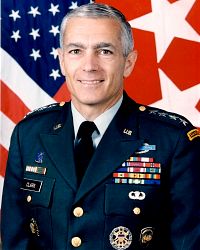
BREAKING: Wesley Clark reportedly called Hillary tonight, urging her to drop out

by · 5/07/2008 02:13:00 AM ET · Link

We've just been told that General Wesley Clark, a strong Clinton supporter and fellow Arkansan, called Hillary tonight to tell her it's over.

In addition to our source, the king of the pundits, Mark Halperin, drops a tantalizing hint that something might be up with Clark:
"The biggest question: Will any of her supporters (including Wes Clark) say publicly or privately she should quit?"
We like General Clark here at AMERICAblog, and have a bit of a history with him. So we hope what we're hearing is true. But the general better watch it - this could be his most dangerous mission to date. When you take on the Clintons, the sniper fire is real.
My observation Gen Clark want to be Obamas V.P. good counter punch to McCain get a respected General on Obamas ticket.